Youjelly: A Playful Handwritten Font That Feels Like Real Ink
I opened a blank brand board last Tuesday for a local ceramicist’s rebrand—think hand-thrown mugs, earthy glazes, and quiet studio energy. Her brief asked for warmth, authenticity, and just a whisper of joy. No corporate polish. No sterile minimalism. I scrolled past three “friendly” script fonts that felt like stock illustrations, then landed on Youjelly. Within ten minutes, I’d typed her shop name in it over a watercolor texture—and paused. Not because it was perfect, but because it breathed. That’s rare with a Script Handwritten typeface.
What Youjelly Actually Looks Like in Practice
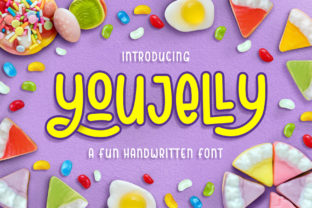
Youjelly isn’t fussy. It’s not overly connected or tightly kerned like some premium script fonts. Instead, it has generous spacing, slightly bouncy letterforms, and subtle irregularities—like ink catching on handmade paper. The lowercase a, g, and y have soft, open counters; the capitals have gentle swashes that don’t dominate. There’s no forced drama—just a relaxed, human rhythm. It reads as joyful without tipping into cartoonish. Think “hand-lettered by someone who loves coffee and sketchbooks,” not “designed to go viral.”
Where It Shines (and Where It Steps Back)
I tested Youjelly across six real touchpoints:
- Logo draft: Paired with a clean sans serif for the tagline, it gave instant personality—especially at medium sizes (48–96pt). On a mockup of her studio sign, it held up beautifully under natural light.
- Packaging label: Printed on kraft sticker stock? Delightful. The slight variation in stroke weight added tactility, like something stamped by hand. But below 14pt, legibility softened—so I reserved it for product names only, not ingredients or care instructions.
- Business card: Used for her name, set large and centered. Paired with Inter for contact details. Clients noticed it immediately—not because it shouted, but because it felt intentional and kind.
- Website hero section: Worked well at 64px on desktop, but I scaled back to 42px on mobile. Still legible, though I avoided long headlines—Youjelly is strongest as a display font for short phrases (“Handmade Daily,” “Glazed With Care”).
- Social media layout: Perfect for Instagram story text overlays and Reel captions. Its whimsical tone matched her behind-the-scenes content without competing with photos.
- Editorial design: Used sparingly—in a newsletter header or chapter opener. Never for body copy. It’s not built for paragraphs, and trying to force it there undermines both readability and its charm.
Youjelly isn’t meant for legal disclaimers, financial reports, or enterprise SaaS dashboards. It’s not a workhorse—it’s a highlighter. A smile in type form. Use it where you want people to pause, feel, and remember.
Pairing It Without Overthinking
I tried Youjelly with half a dozen companions. It plays especially well with warm, grounded typefaces—not cold tech fonts. My go-to pairings:
- A friendly sans serif like Manrope or Commissioner for balance—clean enough to ground Youjelly’s playfulness, but with enough character to avoid feeling sterile.
- A low-contrast serif like Cormorant Garamond for editorial depth—great in lookbooks or printed catalogs where Youjelly handles titles and the serif carries body text.
- A second handwritten font? Only if it’s distinctly different in weight and rhythm—say, a tighter, monoline script for subheads. Two bouncy scripts together get visually noisy fast.
No ligatures or stylistic alternates ship with Youjelly—but honestly, I didn’t miss them. Its strength is in its simplicity and consistency. It comes in one weight (regular), as a desktop font (OTF), and includes basic Latin characters. No multilingual support, so keep that in mind for global-facing projects. And yes—it’s webfont-ready via standard @font-face embedding, though always test loading performance on slower connections.
A Quick Reality Check Before You Commit
Before using Youjelly in client work—especially for packaging, merchandise, or digital templates—double-check the commercial license. Some versions allow unlimited use; others restrict resale (e.g., if you’re bundling it into a Canva template or Shopify theme). A quick read of the EULA saves headaches later. Also: preview it in context. Type your actual headline—not “The quick brown fox”—and drop it onto a mockup of your final medium. Does it still feel right when it’s not isolated on a white screen?
Youjelly won’t solve every branding challenge. But when your project needs honesty, approachability, and a little lightness—when “professional” doesn’t mean “impenetrable”—it’s a genuinely thoughtful tool. Not flashy. Not trend-chasing. Just quietly, confidently human.