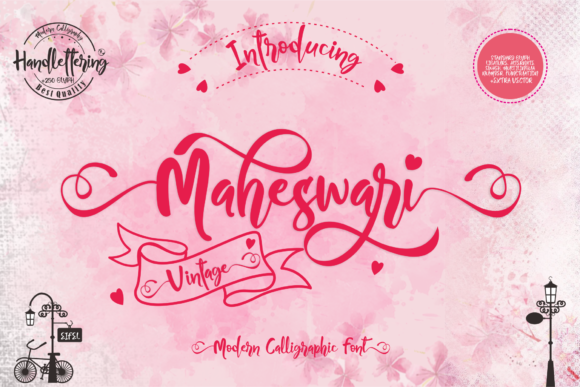
Maheswari: A Modern Calligraphy Font That Feels Like Hand-Drawn Magic
There’s that quiet moment—just before pressing “print”—when you zoom in on a candle label mockup and hold your breath. The scent of soy wax is still faint in the air, your sticker cutter hums softly nearby, and the phrase “Lavender & Rain” sits in Maheswari across the label preview. It’s not just words anymore. It’s texture. It’s warmth. It’s the kind of elegant imperfection that makes customers pause, tilt their head, and think, someone made this with care.
Maheswari is a Script Handwritten typeface built for makers who value both artistry and authenticity. Its modern calligraphy style balances fluid rhythm with intentional structure—soft entry strokes, confident exits, subtle contrast between thick and thin lines, and gentle, organic movement. It doesn’t try to mimic ancient ink or rigid copperplate. Instead, it feels like a contemporary hand—confident, expressive, and quietly refined. Whether you’re designing wedding welcome boards or seasonal printable wall art, Maheswari brings a human pulse to every surface it touches.
I first used Maheswari on a set of handmade greeting cards for spring—a simple “Hello, Sunshine” on kraft cardstock. Printed at 24pt, the curves held beautifully; even the fine hairlines stayed crisp on my home printer. Later, I scaled it down to 10pt for boutique gift tags—and while I wouldn’t recommend Maheswari for dense body text, those tiny tags worked because they carried only one word: “Joy,” “Grateful,” “Bloom.” That’s where this font shines: short, evocative phrases, names, titles, and decorative accents. Think “Est. 2023” on a ceramic mug, “The Wildflower Co.” on a cotton tote, or “Hand-Poured” on a soy candle jar.
For packaging and labels, Maheswari adds instant perceived quality. Its graceful letterforms signal intentionality—not mass production, but thoughtful curation. On matte-finish sticker sheets, it cuts cleanly with my Cricut Maker (especially when using the “cut edge” setting and smoothing outlines in Design Space). For Silhouette users, I always convert to outlines first—Maheswari’s subtle swashes and alternate characters stay intact, giving you room to choose between a more restrained “A” or one with a looping flourish. Just remember: test-cut at 1.5x size first, then scale down. Those delicate terminals love breathing room.
Seasonal product design is where Maheswari truly sings. Last December, I layered it over a minimalist evergreen illustration for digital holiday tags—“Warm Wishes,” “Gather Joy,” “Made With Love.” Paired with a clean sans serif like Montserrat Light for the date or small details, the contrast felt balanced and inviting. For wedding stationery, I used Maheswari for names and ceremony details, then dropped in a soft serif (like Playfair Display) for addresses and RSVP instructions. The pairing creates hierarchy without competing—Maheswari leads with heart, the supporting font grounds with clarity.
It’s also become my go-to for printable planner pages and digital downloads. When clients open a PDF of a floral-themed habit tracker or a moon-phase journal cover, Maheswari’s rhythm invites them in—not as passive viewers, but as participants in something gentle and intentional. On screen, it renders smoothly across devices. In print, it holds its character even on uncoated paper, thanks to its generous x-height and open counters.
Before using Maheswari commercially—whether on physical products like mugs or shirts, or digital templates sold on Etsy—you’ll want to check what’s included. Most versions offer OTF and TTF files, basic Latin multilingual support (covering English, Spanish, French, German, and more), and at least one weight with standard ligatures and stylistic alternates. Some include bonus swash capitals and ending forms—perfect for customizing “&” symbols or adding elegance to monograms. Always verify the license allows commercial use for your specific application: physical goods, printables, SVG cut files, or social media graphics.
Readability matters—especially when your font lives beyond the screen. On small product labels (under 12mm tall), stick to uppercase or bolded single words. For shop signage or farmhouse-style wooden signs, go large—36pt and up—where Maheswari’s natural flow can stretch and breathe. Avoid cramming it into tight spaces or low-resolution mockups; it deserves space to express itself. And if you’re layering it over photos or textured backgrounds, add a subtle white stroke or soft drop shadow in your design software—just enough to keep every curve legible.
What surprises me most about Maheswari isn’t just how beautiful it looks—but how consistently it supports my brand voice. It’s not fussy. It’s not trendy in a fleeting way. It’s warm, grounded, and quietly confident—like the best handmade goods. Whether I’m sketching a concept on paper or fine-tuning a Canva listing image, Maheswari helps translate intention into visual language. It turns “handmade” from a descriptor into a feeling.
So next time you’re choosing a font for your next batch of greeting cards, candle labels, wedding invitations, or printable wall art—pause before reaching for the familiar. Try Maheswari. Type out your shop name. Test “Thank You” on a sticker sheet. Lay it over a neutral background and watch how it shifts the mood of the whole composition. Because great typography isn’t just about letters—it’s about resonance. And Maheswari resonates.
- Perfect for: candle labels, greeting cards, wedding stationery, printable wall art, planner pages, boutique tags, mugs, totes, and seasonal digital downloads
- Best used for: names, titles, short phrases, decorative headings, and display text—not long paragraphs
- Ideal pairings: clean sans serifs (Montserrat, Poppins), soft serifs (Cormorant Garamond), or minimal handwritten companions (for contrast, not competition)
- Pro tip: Enable OpenType features in Adobe apps or Affinity Designer to access swashes and alternates—then manually select the ones that suit your project’s tone
- Licensing note: Confirm commercial rights for physical merchandise, digital templates, and resale-ready design assets before finalizing your product launch