Thumbelina Handwritten Font for Crafters & Sellers
If you’ve ever held a handmade candle, admired a boutique gift tag, or paused over a wedding welcome sign that felt *just right*, you know how much a font can shape the feeling—and the sale—of your product. That’s why Thumbelina has become my go-to Script Handwritten font for projects where warmth, charm, and quiet confidence matter most.
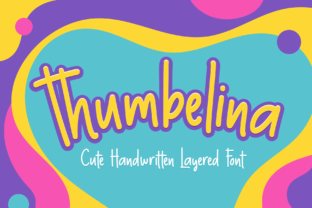
Thumbelina isn’t fussy or overly ornate. It’s sweet and friendly—like a handwritten note from someone who cares deeply about details but doesn’t take themselves too seriously. The letterforms have gentle curves, soft entry and exit strokes, and just enough personality to stand out without sacrificing clarity. It’s not a calligraphy font with dramatic flourishes, nor is it a rigid monoline script. Instead, Thumbelina strikes that rare balance: expressive enough for emotional impact, readable enough for real-world use.
Where Thumbelina Shines in Physical & Digital Products
I use Thumbelina across nearly every category I design for—labels, stickers, invitations, wall art, planner pages, SVG cut files, and printable templates. Its versatility lies in its thoughtful construction: letters sit comfortably at small sizes (down to 10–12pt on printed labels) and scale beautifully up to 300+ pt for wooden signs or canvas prints.
- Candle & soap labels: Thumbelina adds handmade authenticity to apothecary-style packaging. I pair it with a clean sans serif (like Montserrat or Poppins) for ingredients and weight—keeping the brand voice warm but trustworthy.
- Wedding stationery: From “Mr. & Mrs.” on foil-stamped invites to “Welcome” on chalkboard-style signage, Thumbelina conveys tenderness without looking juvenile. It reads clearly even when laser-cut into wood or vinyl.
- Digital printables: For planner stickers, habit trackers, or quote-based wall art PDFs, Thumbelina gives instant visual cohesion. Customers tell me it “feels like it was made just for them”—a huge win for digital downloads.
- Seasonal crafts: Easter tags, Christmas mug wraps, and Valentine’s Day cards all benefit from Thumbelina’s gentle rhythm. Unlike some playful fonts, it avoids looking dated or cutesy—it feels timeless, not trendy.
Readability Meets Real-World Production
Let’s talk practicality: if your font doesn’t cut cleanly on Cricut or Silhouette machines—or doesn’t render crisply in mockups—you’ll waste time and materials. Thumbelina holds up well because its strokes are consistent in weight and spacing. No tight loops or ultra-thin terminals that break when scaled down. I’ve used it successfully on 0.75" sticker dots, 4" retail tags, and 24"x36" framed prints—all without kerning adjustments or manual tweaks.
For small-format use—think jar labels, tea bag tags, or mini greeting cards—I recommend using Thumbelina for short phrases only: names, titles, single words (“Joy,” “Bloom,” “Handmade”), or short quotes. It’s not designed for body text, and trying to force it into paragraphs dilutes its charm. Save it for moments where you want attention, emotion, and intentionality.
Smart Pairings & Design Consistency
Thumbelina works best when paired intentionally. My default pairing is Thumbelina + a neutral sans serif—often with slightly rounded corners for continuity (like Nunito or Quicksand). This combo gives you contrast without competition: the handwritten font carries heart, while the sans serif delivers structure and legibility.
For vintage or farmhouse aesthetics, I sometimes layer Thumbelina over a light serif (like Playfair Display) in subtle background text—but always keep Thumbelina as the focal point. The key is preserving its handmade feel while anchoring it in something stable. Avoid pairing it with other scripts or decorative fonts; that’s where readability and brand clarity start to fray.
Licensing, Files & What You’ll Actually Use
Thumbelina comes in standard OTF and TTF formats—fully compatible with Canva, Adobe Creative Cloud, Cricut Design Space, Silhouette Studio, and Procreate. There are no hidden layers or complex vector requirements, which means faster setup and fewer export headaches.
It includes basic OpenType features: stylistic alternates for lowercase “a,” “g,” and “y,” plus common ligatures (like “fi” and “fl”) that improve flow in longer words. While it doesn’t include extensive language support beyond Western European characters, it covers everything needed for English-language product labels, social media graphics, and Etsy listings.
Most importantly: Thumbelina is licensed for commercial use. That means you can confidently use it in client work, sell physical products with Thumbelina-based designs (mugs, shirts, tote bags), bundle it into editable Canva templates, or embed it in SVG files for digital download shops. Just be sure to review the license terms before mass-producing merchandise—some sellers overlook that step, and it’s worth double-checking.
Why Thumbelina Builds Better Brand Moments
Your font choice quietly tells customers who you are before they read a single word. Thumbelina signals care, approachability, and craftsmanship—not perfection, but presence. When someone sees Thumbelina on a lavender sachet label or a baby shower invitation, they don’t just see text—they sense intention.
That emotional resonance translates directly to perceived value. Buyers pay more for products that feel personal, and Thumbelina helps handmade sellers elevate their offerings without expensive photography or custom illustration. It’s a subtle tool—but one that consistently lifts the professionalism and warmth of my shop’s entire visual identity.
Whether you’re designing for Etsy, local markets, or wholesale boutiques, Thumbelina fits seamlessly into your workflow—not as a novelty, but as a reliable, expressive, and commercially sound Script Handwritten typeface. It’s the kind of font you reach for when you want your product to say, “I made this with love—and I hope you feel it.”